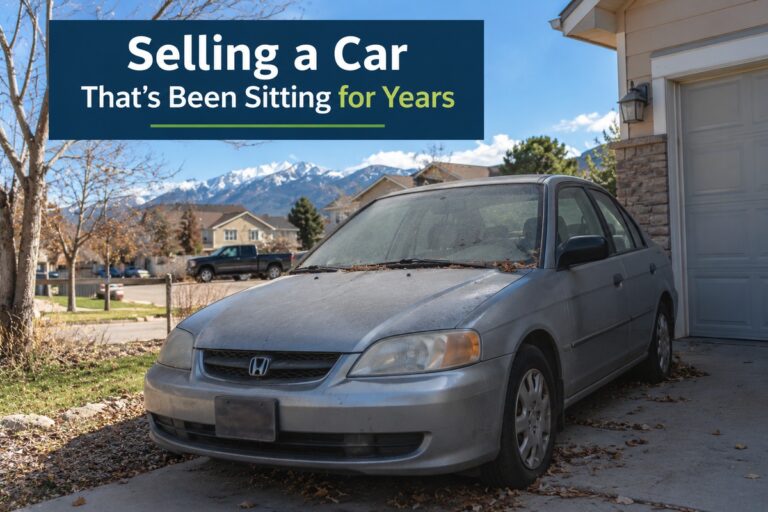
Selling a car that’s been sitting for years can seem complicated, especially when the vehicle no longer starts, has expired registration, or has developed mechanical problems from long-term storage. Whether the car has been parked in a garage, driveway, backyard, or storage lot, it may still have value and can often be sold without investing money into major repairs.
For Colorado vehicle owners, weather and long periods of inactivity can create additional problems. Batteries die, tires lose air, fluids deteriorate, brakes rust, and rodents may find their way into an unused vehicle. Understanding the condition of your car and your selling options can help you avoid unnecessary expenses and get the vehicle off your property.
What Happens to a Car After Sitting for Several Years?
Cars are designed to be driven regularly. When a vehicle sits unused for months or years, deterioration can happen even when the car was running well when it was originally parked.
The exact condition depends on where the vehicle was stored, how long it has been sitting, and whether anyone performed basic maintenance during that time. A vehicle kept inside a dry garage will typically age differently from one left outside through several Colorado winters.
Common Problems With Cars That Have Been Sitting
A long-sitting vehicle can develop multiple issues at the same time. Some are relatively inexpensive, while others can make repairing the car impractical.
Common problems include:
- A dead or damaged battery
- Flat, cracked, or dry-rotted tires
- Rusted brake rotors and seized brake components
- Old gasoline or contaminated fuel
- Deteriorated engine oil and other fluids
- Leaking hoses, seals, and gaskets
- Rust on the body, frame, exhaust, or suspension
- Rodent damage to wiring, insulation, and air filters
- Mold, moisture, or unpleasant odors inside the vehicle
- Electrical problems
- Engine or transmission problems
- Missing or damaged parts
The longer a car has been sitting, the greater the chance that several of these issues will be present.
Should You Try to Start a Car That Has Been Sitting for Years?
Trying to start an old vehicle immediately is not always the best idea. If a car has been sitting for several years, simply installing a new battery and turning the key could create additional problems.
Old fuel may have degraded, fluids may be low, belts can be brittle, and rodents may have damaged electrical wiring. Depending on the vehicle and how long it has been parked, it may be safer to inspect it before attempting to start it.
Check the Vehicle Before Starting It
If you are considering getting the car running before selling it, inspect the basic components first.
Look for:
- Fluid leaks underneath the vehicle
- Damaged or chewed wiring
- Cracked belts and hoses
- Extremely low or contaminated fluids
- Rodent nests under the hood
- Missing engine components
- Signs of severe corrosion
- Damaged fuel lines
- Flat or deteriorated tires
If the car is already being sold as a junk car or non-running vehicle, getting it started may not be necessary at all.
Decide Whether the Car Is Worth Repairing Before Selling
One of the biggest decisions when selling a car that has been sitting for years is whether to repair it first.
It can be tempting to assume that spending money on repairs will automatically increase the selling price. That is not always the case. An older vehicle may need a battery, tires, brakes, fuel-system work, towing, and additional repairs before it becomes dependable again.
Compare Repair Costs With the Car’s Potential Value
Before paying for repairs, estimate what the vehicle would realistically be worth in running condition. Then compare that figure with the cost required to make it roadworthy.
For example, a car might need $2,500 in repairs but only be worth $3,000 to $4,000 once everything is completed. The additional time, towing costs, diagnostic fees, and uncertainty may make repairing it a poor financial decision.
For a junk car or older high-mileage vehicle, selling it as-is may make more sense.
You Can Sell a Car That Does Not Run
A vehicle does not necessarily need to start or drive to have value. There are buyers for non-running cars, damaged vehicles, junk cars, and vehicles that have been sitting for extended periods.
The important part is being accurate about the vehicle’s condition.
When requesting an offer, provide information such as:
- Year, make, and model
- Approximate mileage
- Whether the vehicle starts
- Whether it can move under its own power
- Condition of the engine and transmission, if known
- Accident or body damage
- Missing parts
- Rust or corrosion
- Condition of the tires
- How long the vehicle has been sitting
- Whether you have the title and other available paperwork
Providing accurate information can make the process of selling a non-running car much easier.
Clean the Car Enough to Inspect It
You usually do not need professional detailing for a vehicle that has been sitting for years, particularly if you plan to sell it as a junk car.
Basic cleanup can still be helpful. Remove trash and personal belongings so you can inspect the interior and trunk. Clear leaves, branches, snow, or debris from around the vehicle so its exterior condition is visible.
Remember to Check for Personal Belongings
Cars that have been parked for years sometimes become unofficial storage spaces. Before the vehicle leaves your property, check:
- Glove compartment
- Center console
- Door pockets
- Under the seats
- Seatback pockets
- Trunk or cargo area
- Spare tire compartment
- Sun visors
Remove paperwork containing personal information along with garage door openers, toll devices, keys that belong to something else, and any other personal property.
Find the Title and Vehicle Information
Paperwork is something to address early when you want to sell an old car in Colorado.
Locate the vehicle title if you have it and make sure you know whose name appears on it. You should also locate the VIN, which is commonly visible through the driver’s side windshield and may appear in other locations on the vehicle.
If the title is missing, damaged, or contains outdated information, investigate the applicable Colorado title requirements before arranging the sale. Resolving paperwork issues early can prevent delays when you find a buyer.
Determine Whether It Is a Used Car or Junk Car
A car that has been sitting for years is not automatically a junk car. Some vehicles can be restored or returned to the road with relatively straightforward repairs.
Others are worth more as an as-is vehicle because repairing them would cost too much.
Signs Selling as a Used Car May Make Sense
Selling the vehicle as a used car may be reasonable when:
- It has relatively low mileage
- The engine and transmission are in good condition
- It was running when recently parked
- The body and frame are solid
- The vehicle is desirable or collectible
- The repairs needed are minor compared with its market value
Signs It May Be Better to Sell as a Junk Car
Selling to a junk car buyer may be more practical when:
- The vehicle has not run in several years
- Repair costs exceed or approach its value
- It has major engine or transmission problems
- There is extensive rust or collision damage
- Important components are missing
- The tires and brakes are badly deteriorated
- The car cannot be safely driven
- You want to sell the vehicle without making repairs
This distinction can save you from spending hundreds or thousands of dollars trying to prepare a vehicle that will still have limited resale value.
Consider the Cost of Towing a Non-Running Car
Transportation can become a major issue when selling a car that has been sitting for years. Even if the engine starts, deteriorated tires, brakes, or other components may make the vehicle unsafe to drive.
If the car does not run, it will generally need to be transported rather than driven away.
Before accepting an offer, find out who is responsible for moving the vehicle and whether towing affects the amount you will receive. A seemingly higher offer may become less attractive if you have to arrange and pay for transportation yourself.
Avoid Spending Money on Repairs You Do Not Need
If your primary goal is getting rid of an old car, resist the urge to replace every worn component before finding out what the vehicle is worth as-is.
A new battery alone may not get a long-sitting car back on the road. Once repairs begin, you might discover additional problems with the fuel system, brakes, tires, cooling system, electrical components, or engine.
Getting an as-is offer first gives you a useful number to compare against potential repair costs.
Be Accurate When Describing How Long the Car Has Been Sitting
There is a significant difference between a car that has been parked for six months and one that has been sitting untouched for eight years.
Tell potential buyers approximately when the vehicle was last driven and why it was parked, if you know.
Useful details might include:
- It was running when parked
- It stopped running because of a specific mechanical problem
- It was parked after an accident
- It has not been started in several years
- It has been stored indoors
- It has been exposed to Colorado weather
- Previous repair estimates are available
You do not need to diagnose problems you cannot confirm. Simply provide the information you know.
Selling a Car That Has Been Sitting Outside in Colorado
Colorado weather can be tough on a vehicle that remains outdoors year after year. Snow, ice, intense sunlight, temperature changes, and moisture can all contribute to deterioration.
Pay particular attention to rust, faded paint, cracked rubber, tire condition, and damage underneath the vehicle. Snow and moisture can also contribute to corrosion around brake and suspension components.
A car does not have to look good to be sellable. Exterior deterioration simply needs to be considered when determining its condition and value.
What Determines the Value of a Car That Has Been Sitting?
There is no single price for an old non-running vehicle. Two cars that have been sitting for the same amount of time can have very different values.
Several factors can influence an offer, including:
- Make and model
- Model year
- Mileage
- Overall condition
- Whether the engine runs
- Engine and transmission condition
- Body and frame condition
- Accident damage
- Rust
- Missing parts
- Demand for the vehicle or its components
- Title status
- Location of the vehicle
Do not assume the vehicle is worthless simply because it does not run. Even a junk car can have value based on its usable components, vehicle type, condition, and other factors.
Prepare the Area Around the Vehicle for Removal
If a car has been sitting in the same place for several years, removing it may require more than simply hooking up a tow truck.
Tires may be completely flat, wheels may be stuck, and brakes can seize. Vegetation may have grown around the vehicle, or another car may be blocking access.
Before pickup, make sure there is a reasonable path to the vehicle. Move other vehicles when possible and clear objects that could interfere with removal.
Tell the buyer in advance if the car is in a difficult location, such as behind a house, inside a tight garage, down a steep driveway, or on soft ground. This information can help the buyer prepare the right equipment.
Selling an Old Car As-Is Can Save Time and Money
For many owners, the biggest advantage of selling a car as-is is avoiding the repair process altogether.
Instead of paying for towing to a mechanic, diagnostics, replacement parts, labor, registration-related expenses, and other costs, you can sell the vehicle based on its current condition.
This approach can be particularly useful for:
- Junk cars
- Non-running vehicles
- High-mileage cars
- Cars with mechanical problems
- Damaged vehicles
- Vehicles with significant rust
- Cars that have been sitting for several years
An as-is sale can also help free up a driveway, garage, parking space, or property area that has been occupied by an unused vehicle.
Get an Offer Before Assuming the Car Has No Value
A car that has been sitting for years may look like little more than a problem taking up space, but appearance alone does not determine whether someone will buy it.
Before paying for extensive repairs or arranging to have the vehicle hauled away, get an offer based on its actual condition. Provide accurate details about the vehicle, how long it has been sitting, and whether it currently runs.
If you are looking to sell a used car, junk car, damaged car, or non-running vehicle in Colorado, Sell My Car Colorado can provide an option for selling the vehicle as-is. Even if the car has been parked for years and no longer runs, it may still have value.
Selling a car that’s been sitting for years does not have to involve restoring it to driving condition first. By checking the vehicle, locating the paperwork, comparing repair costs with its realistic value, and considering an as-is sale, you can choose the option that makes the most financial sense and finally get the unused car off your property.
Content reviewed and published by Sell My Car Colorado Editorial Team.